|
Junseok (June) Oh Hi, I'm Junseok. I am a Software Engineer on the Search Ads AI team at Google and an MSE graduate in Data Science from the University of Pennsylvania. My research aims to push the frontiers of foundational multimodal intelligence—bridging multimodal foundation models with real-time embodied perception to build systems that seamlessly perceive, reason, and interact in the open world. Specifically, I study multimodal social attention: how an agent infers who needs attention, what matters in the moment, and when assistance is appropriate using cues like gaze, head orientation, language, and turn-taking. At the MIT Media Lab Personal Robots Group (mentored by Dong Won Lee and Dr. Hae Won Park), I currently work on multimodal egocentric head-gaze prediction and real-time referential control. Previously, I conducted health-focused research spanning smartphone-based biosensing and single-cell analysis. I hold a B.S. in Computer Science with a minor in Mathematics from Purdue University. |
|
News |
| Mar 2026 | Joined Google as a Software Engineer on the Search Ads AI team. |
Research |
|
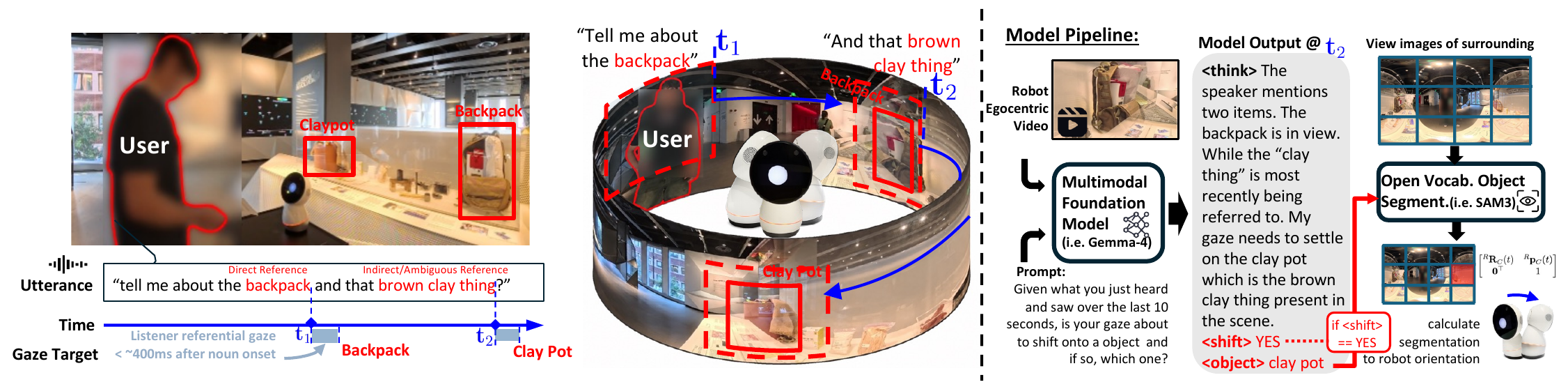
Real Time Open-Vocabulary Referential Gaze Control for Listening Robots
Dong Won Lee, Junseok Oh, Sarah Gillet, Chaitanya Ahuja, Andrea Tagliabue, Yoon Kim, Louis-Philippe Morency, Cynthia Breazeal, Hae Won Park In Submission project page While listening, a robot must infer from streaming speech and visual context whether to shift gaze, what to look at, and where the referent is. We combine a multimodal foundation model and object segmentation with privileged information distillation to achieve low-latency, open-vocabulary referential gaze control. |
|
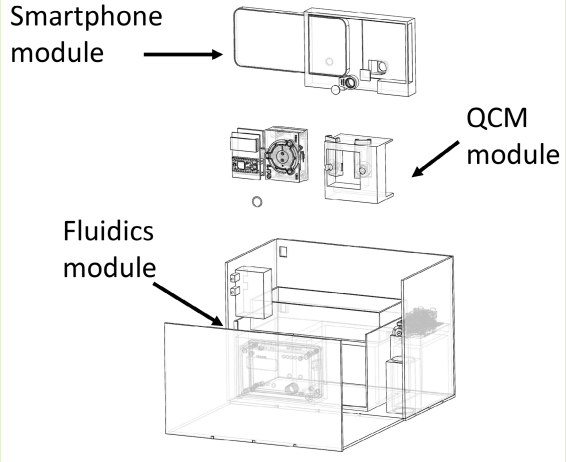
Smartphone-Integrated Optomechanical Dual-Mode
Instrument for Salmonella Typhimurium Detection
Hyun Jung Min, Hansel A. Mina, Junseok Oh, Amanda J. Deering, J. Paul Robinson, Bartek Rajwa, Euiwon Bae IEEE Sensors Journal, 2025 paper We develop a smartphone-integrated, optomechanical dual-mode biosensing instrument that combines vision-based readout with frequency-shift measurements to enable low-cost, rapid detection of Salmonella Typhimurium for practical food-safety monitoring. |
Research Projects |

|
K-BioX - Stanford
Cardiovascular Institute
Built an automated scRNA-seq pipeline over public GEO datasets to compare adult vs. P12 developmental stages, then used GSEA, cell-to-cell interaction profiling, and PCA/UMAP to surface adipogenesis/angiogenesis signals across epicardial adipose tissue (EAT) datasets. |

|
Wittgen Biotechnology -
UC Berkeley SkyDeck
Worked on ML for high-resolution tumor classification and tailored drug recommendations by processing RNA-seq data from 40+ cancer patients, contributing to an AI platform for cancer heterogeneity profiling, and using Seurat for single-cell analysis and cell-type differentiation. |
Teaching |

|
CS 25200 - Systems Programming
Undergraduate TA, Spring 2023 |
|
Template based on Jon Barron's website; see Leonid Keselman's Jekyll fork. |